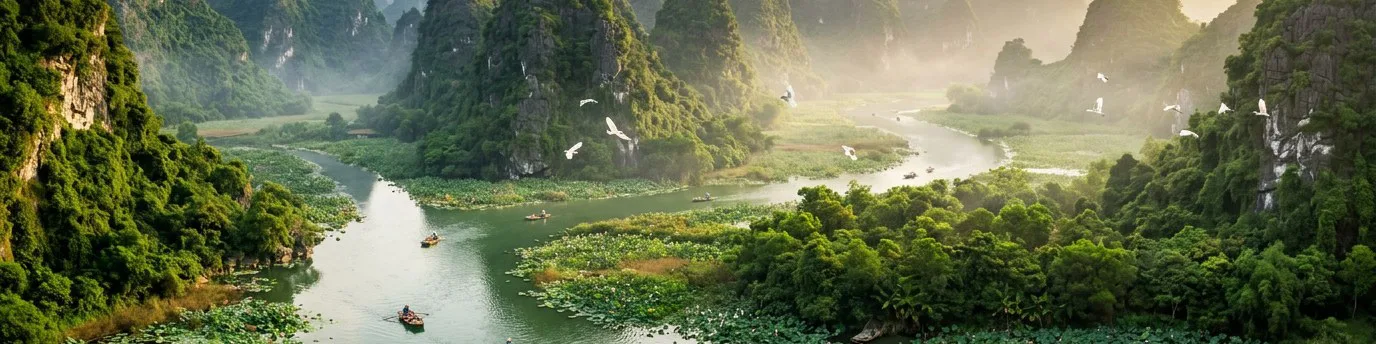
Recognized among the oldest and most expansive tropical karst landscapes on Earth, Phong Nha-Ke Bang National Park in Quang Binh Province spans more than 200,000 hectares of rugged limestone mountains and ancient primary forest. Beneath this emerald canopy lies an extraordinary subterranean labyrinth of more than 300 large and small caves filled with underground rivers, cathedral-scale chambers, and rare cave-adapted wildlife. Planning a Phong Nha cave travel itinerary introduces explorers to seven signature caverns and spring-fed valleys that showcase the geological grandeur of Central Vietnam.
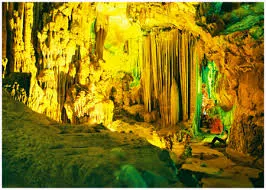
Boat Caves and Underground Palaces: Phong Nha, Paradise, and Tien Son
Phong Nha Water Cave
With a surveyed length of nearly 8 kilometers, Phong Nha Cave stands out internationally for harboring one of the longest underground rivers in the world. Visitors begin their journey at the Son River boat landing, boarding traditional motorboats that glide smoothly upstream past karst bluffs and riverside villages straight into the yawning cave portal. Even at the height of Quang Binh's blazing summer sun, the microclimate inside the cavern remains refreshingly cool and crisp between 17°C and 19°C.
After cruising more than 600 meters along the tranquil subterranean waterway with boat engines switched off in favor of wooden paddles, travelers disembark onto sandy interior banks to explore illuminated dry galleries. Highlights include Bi Ky Grotto—marked with ancient Cham inscriptions—alongside Co Tien (Fairy) Grotto and Cung Dinh (Imperial Court) Grotto. Inside these soaring limestone halls, multicolored stalactites, glittering calcite draperies, and soft wind echoes whispering through rock flutes create the thrilling sensation of walking inside a mythical subterranean cathedral.
Paradise Cave (Thien Duong Cave)
Celebrated across Asia as an "Underground Royal Palace," Paradise Cave sits in Bo Trach District at Kilometer 16—nearly 4 kilometers off the West Branch of the Ho Chi Minh Highway and roughly 20 kilometers beyond Phong Nha Cave. Tucked inside an ancient limestone massif at an elevation of 191 meters and encircled by untouched rainforest, Paradise Cave is acclaimed as the longest dry cave in Asia. Its surveyed passages stretch an astonishing 31.4 kilometers, with chamber widths ranging from 30 to 100 meters—expanding to 150 meters at its grandest hall—and vaulted ceilings rising approximately 60 meters overhead.
Stepping down the wooden boardwalk into the cavern reveals countless crystalline stalactites and stalagmites sculpted over millions of years into evocative forms named by early explorers. In the Thach Hoa Vien (Stone Flower Garden) chamber, luminous gypsum and calcite formations resemble a serene statue of the Virgin Mary cradling a child. Deeper inside, the majestic Giao Tri Palace evokes the celestial throne room of the Jade Emperor surrounded by attentive courtiers, flanked by intricate natural sculptures of mythical unicorns and phoenixes. Because Paradise Cave is a dry cavern, its formations display even finer crystalline delicacy than river-carved caves, and visitors can easily book combined one-day guided tours covering both Phong Nha Cave and Paradise Cave.
Tien Son Dry Cave
Directly pairing with the wet river passage below, Tien Son Cave forms the upper half of the celebrated Phong Nha – Tien Son twin wonder. Perched at an altitude of roughly 200 meters above the ceiling of Phong Nha Cave, Tien Son stretches 980 meters into the cliffside as a purely dry cavern that does not connect internally to the underground river beneath it. Climbing up to Tien Son rewards visitors with terraced flowstone columns, translucent mineral curtains, and resonant stone slabs that ring like bronze gongs when gently tapped. Local legend likens Phong Nha Water Cave below to the underwater palace of the Dragon King (Vua Thuy Te), while lofty Tien Son above represents the heavenly court of the Jade Emperor graced by graceful fairy silhouettes.
Adventure Caving in Hang En and Pristine Dark Cave
Hang En (Swallow Cave)
Cutting 1,645 meters straight through a towering karst ridge, Hang En boasts three monumental entrances: one perched halfway up the mountainside and two opening at the southeastern and northwestern foothills along the winding course of the Rao Thuong Stream. Unlike electrically lit show caves, Hang En captivates trekkers with translucent jade-blue river pools inside the cavern and dramatic sunbeams pouring down through lofty ceiling skylights onto sandy interior beaches. High along sculpted ceiling ledges nest thousands of swiftlets, swallows, and bats—the lively avian colony that inspired the name Swallow Cave.
Because dense primary rainforest surrounds the valley, entering without a licensed guide and ranger team is dangerous and strictly discouraged. Reaching Hang En involves a strenuous wilderness trek covering more than 10 kilometers each way—totaling nearly 30 kilometers round-trip—descending and ascending 500-meter mountain passes and wading repeatedly across clear jungle streams. Prospective trekkers should maintain good cardiovascular fitness and train beforehand, much as travelers prepare carefully through practical ecotourism preparation and trekking guides before tackling remote wilderness routes.
Dark Cave (Hang Toi)
Surveyed by expeditions of the British Cave Research Association in 1990 and 1992 as a major branch of the Phong Nha system, Dark Cave greets explorers with a dramatic riverside portal measuring 20 meters wide and 40 meters high. Combining both subterranean river channels and elevated dry passages, the cave extends 5,258 meters in length with ceilings reaching up to 80 meters high. British speleologists named it Dark Cave because the pitch-black darkness inside its inner corridor feels almost dense enough to reach out and touch.
Inside, thousands of untouched stone columns shelter colonies of bats and swiftlets, while the sheer limestone cliffs outside serve as vital sanctuary for the endangered Hatinh langur—a rare endemic primate listed in Vietnam's Red Data Book. Because Dark Cave opens directly onto the humid Chay River gorge, stalactites near its entrance are cloaked in vibrant emerald moss. Intentionally preserved without permanent floodlights, Dark Cave invites adventurous visitors to follow a 1-kilometer wooden walkway and explore deeper chambers solely by the beam of caving headlamps.
Emerald Waters of Suoi Nuoc Mooc and Sinh Ton Valley's Aquarium Cave
Suoi Nuoc Mooc Ecotourism Area
From the Phong Nha Tourism Center, travelers can follow the East Branch of the Ho Chi Minh Road northward to the Khe Gat three-way intersection, then turn west along the West Branch of the Ho Chi Minh Road for roughly 10 kilometers to reach Suoi Nuoc Mooc Ecotourism Area. Alternatively, scenic wooden boats cruise upstream along the Son River and turn more than 6 kilometers up its tributary to arrive at the springs. Set beneath towering rainforest trees and blooming wild orchids, Suoi Nuoc Mooc enchants visitors with cool artesian waters bubbling up from subterranean limestone fissures, bamboo footbridges, kayaking pools, and tranquil riverside hammocks.
Thuy Cung Cave (Aquarium Cave)
Hidden deep within Sinh Ton (Survival) Valley, Thuy Cung Cave captivates trekkers with water of an extraordinary, almost otherworldly jade-turquoise hue. When first discovered, explorers named it Nuoc Xanh (Blue Water) Cave because its hypnotic coloration remained a geological mystery; even after multiple speleological surveys, the exact mineral source behind its luminous blue tint continues to fascinate researchers, who traced its outflow into the cool Lanh Stream before the current plunges underground toward Dark Cave.
Venturing deeper inside reveals multicolored mineral formations reflected in crystal-clear pools and resonant acoustic echoes whenever companions call across the chamber, evoking a living underwater aquarium. Whether gliding gently by boat through illuminated river grottos or trekking across rugged jungle valleys with experienced local guides, Phong Nha-Ke Bang offers itineraries suited to casual sightseers and seasoned explorers alike. Travelers fascinated by freshwater karst wonders often pair Quang Binh expeditions with highland dugout canoe trips on Ba Be Lake in Bac Kan, explore key biodiversity attractions around Ba Be National Park, or contrast cave trekking with island reef and forest travel tips for Phu Quoc.