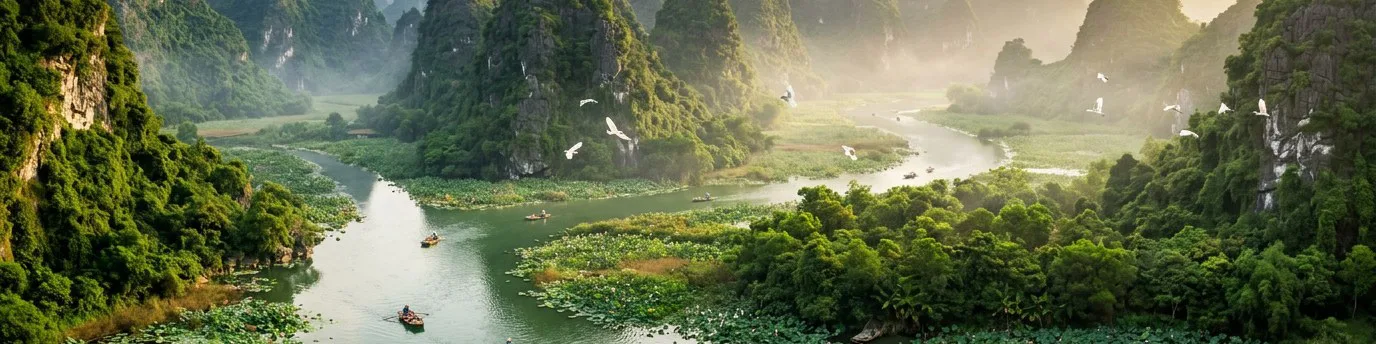
Celebrated as the crown jewel of Bac Kan Province and northeastern Vietnam's highland biosphere network, Ba Be National Park captivates nature travelers with emerald mountain waters, primeval rainforests, and dramatic karst geology. Its unspoiled alpine scenery and living ethnic heritage leave an enduring impression on every visitor who ventures into these misty limestone valleys.
Mountain Highway Routes and the Unique Geology of Three Lakes
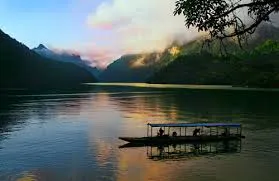
According to geological surveys, Ba Be National Park lies within the sweeping bow of the Song Gam mountain arc, curving gracefully around the Song Chay structural belt. Exposed cliff strata throughout the park preserve vivid geological records of ancient continental crust tectonics and karst uplift. Down at the lakeside pier, a weathered local boatman with a warm, welcoming smile guides passengers aboard a wooden boat onto tranquil blue-green water, where ancient jungle canopies and sheer limestone walls make travelers feel as though they have stepped into a timeless legend among scenic highland parks in Northern Vietnam.
Ba Be Lake sits approximately fifty kilometers northwest of Bac Kan City and roughly two hundred twenty kilometers north of Hanoi. Following National Highway 3 past Phu Thong and Deo Giang Pass—storied historical landmarks of Vietnam's resistance era—travelers turn toward Ba Be District at the Na Phac road junction. From there, a winding asphalt mountain highway threads through vast evergreen forests and quiet hillside hamlets framed by golden terraced rice paddies during harvest season. As the road climbs higher, the mountain climate grows noticeably cooler and purer until old-growth forest trees part around towering blue-gray cliffs to reveal the shimmering mirror of Ba Be Lake.
Stretching roughly nine kilometers in length across approximately 650 hectares of surface water with depths ranging from twenty to thirty-five meters, Ba Be—meaning "Three Lakes"—is formed by three interconnected basins named Pe Lam, Pe Lu, and Pe Leng, fed and linked by the Nang River. Geological core drilling beneath the lakebed uncovered a remarkable natural phenomenon: lining the bottom of the karst basin is a dense, pliable layer of gray clay up to two hundred meters thick, sealing the porous limestone so the lake remains brimming with water high amidst mountain peaks. Scattered across the lake are forested islets sheltering rare plant and animal species listed in both Vietnam's Red Data Book and global conservation registries, rivaling the biodiversity found during ancient rainforest trekking in Cuc Phuong National Park.
Dugout Canoes, Karst Caves, Waterfalls, and Tay Lakeside Homestays
Cruising across the broad ripples, domestic travelers frequently pass international excursion boats—including enthusiastic groups of French nature tourists—photographing the majestic reflection of cliffs on water. Deeper inside the lake basins, local residents cast nets for freshwater fish and shrimp from slender traditional dugout canoes, and every Lunar New Year lakeside communities gather along the shore for the vibrant Ba Be Spring Festival. Whether travelers prefer highland lakes, peaceful coastal retreats at Hai Tien Beach, or sustainable bay conservation at Lang Co Bay, Ba Be stands apart for its seamless harmony between human settlement and wild forest.
Beyond boat cruises along the Nang River and Ba Be Lake, visitors can hike into highland villages of the Tay, Nung, H'Mong, and Dao peoples to browse lively mountain market fairs stocked with upland produce and native forest specialties. Guided park excursions explore spectacular caverns—including Hua Ma Cave perched halfway up a forested mountain slope and the riverside cavern of Puong Cave—follow rocky trails to Dau Dang Waterfall, where roaring whitewater rapids drop sixty meters across an eight-hundred-meter cascade, and trek beneath primeval forest canopies shading heritage trees over one thousand years old.
Many travelers choose to dock at Bo Lu and Coc Toc, tranquil lakeside hamlets nestled along fertile alluvial plains. Even as families welcome overnight guests, traditional Tay culture remains remarkably authentic, with folk arts and customs actively preserved. After an afternoon on the water, visitors stroll quiet village lanes, savor home-cooked mountain dishes, listen to melodic folk songs, and sleep peacefully inside airy wooden Tay stilt houses—confirming Ba Be National Park as a natural heritage treasure of Northern Vietnam.