
Hai Duong Stork Island in Chi Lang Nam Commune, Thanh Mien District, Hai Duong Province rises from the calm, spring-fed waters of An Duong Lake as one of the Red River Delta's most remarkable community-protected bird sanctuaries. Discovered as a major wild roosting ground in 1994, this natural emerald islet—locally known as Dao Co—has grown into a beloved destination for both domestic nature lovers and international ornithologists exploring Hai Duong northern ecotourism itineraries. Spanning an intimate core islet area of 2,382 square meters encircled by shimmering lake waves, the sanctuary shelters tens of thousands of resident and migratory waterbirds beneath ancient bamboo groves and broadleaf trees.
Avian Biodiversity on An Duong Lake in Thanh Mien
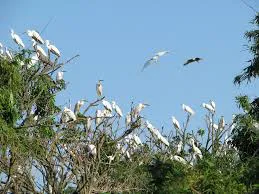
Over the decades, Chi Lang Nam's sheltered microclimate and abundant aquatic food web have attracted nine distinct species of storks, egrets, and bitterns alongside three species of nocturnal night herons. Field surveys around the island record cinnamon bitterns, cattle egrets, Chinese pond herons, black bitterns, intermediate egrets, grey herons, little white egrets, great egrets, and striated herons sharing nesting space with grey night herons, green-backed herons, and black-crowned night herons. Many of these migratory flocks travel thousands of kilometers along East and South Asian flyways from China, Myanmar, India, Nepal, and the Philippines. Spring marks the most spectacular congregation season, when several thousand egrets and thousands of night herons pack every bamboo culm and banyan branch across the reserve.
Because An Duong Lake holds deep, nutrient-rich water throughout every season and never runs dry, its open marshes and reed beds sustain far more than tree-roosting herons. Paddling quietly along the shoreline reveals flocks of common teal, lesser whistling ducks, wild mallards, white-breasted waterhens, and foraging snipes. Most notably, conservationists have documented rare black cormorants and spot-billed pelicans—two vulnerable waterbird species officially listed in the Vietnam Red Data Book—making Chi Lang Nam a vital lowland refuge within our Northern Vietnam nature reserves archive.
Dawn and Dusk Roosting Shifts Across the Sanctuary
Arriving at dawn or late afternoon rewards travelers with the dramatic daily "changing of the guard" between diurnal egrets and nocturnal night herons. Before night herons lift off for their evening foraging flights across surrounding rice paddies, the island canopy erupts in animated calls and rustling wings as incoming and outgoing flocks compete for favored perches. Night herons typically settle into shaded lower bamboo thickets to rest during daylight hours, whereas snow-white egrets claim the sunlit upper branches, stretching the island's compact woodland nearly to full capacity.
At sunset, returning egrets stream across the horizon in graceful V-formations numbering from several dozen to several hundred birds per flock. After circling wide above An Duong Lake in sweeping ribbons against the amber sky, they glide smoothly down onto the island canopy just as squadrons of broad-winged night herons launch outward for an all-night feeding shift. Viewed from a distance in early morning mist or golden afternoon light, thousands of white egrets perched shoulder to shoulder resemble clusters of white cotton blossoms illuminating the green lake.
Boat Excursions and Chi Lang Nam Rural Craft Heritage
Beyond birdwatching, Chi Lang Nam preserves the tranquil cultural fabric of a traditional Red River Delta countryside village. Centuries-old shade trees, ancient carved stone steles, communal houses, ancestral temples, and riverside shrines stand alongside generational artisan trades passed from parents to children, including freshwater fish farming, hand-grilled rice paper craft, delicate steamed rice rolls, and ornamental tree nurseries. Travelers who combine inland bird sanctuaries with coastal reserves such as the Hai Tien Beach coastal ecotourism zone or montane birding routes along Bach Ma National Forest biodiversity trails find that boarding a quiet wooden sampan on An Duong Lake offers an unforgettable, close-range window into Northern Vietnam's living wetland harmony.