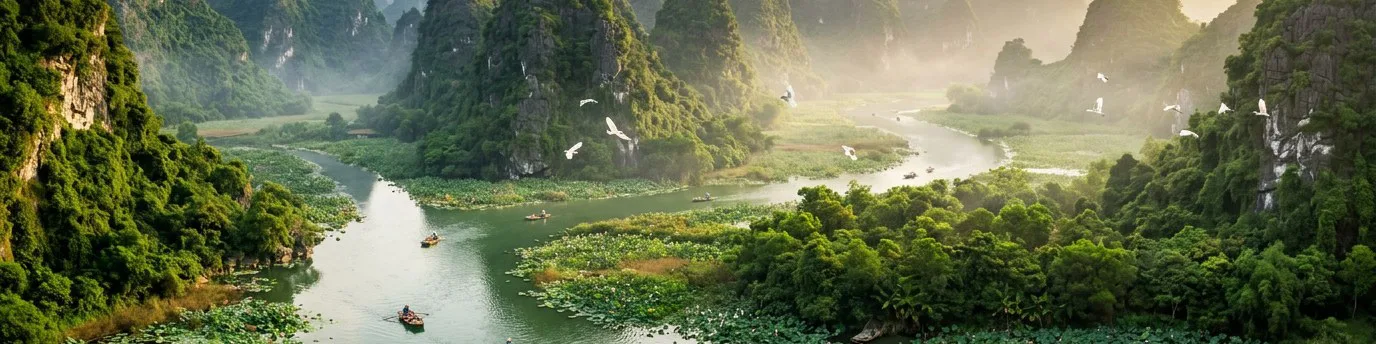
Positioned 50 kilometers south of historic Hue City and 60 kilometers north of Da Nang, Bach Ma National Park encompasses more than 22,030 hectares of rugged coastal mountains and primary evergreen forest. Known in Vietnamese as "White Horse" after the luminous banks of mist that drape its granite ridges, this protected reserve ranks among Central Vietnam's richest ecological sanctuaries. From the Cau Hai junction on National Highway 1A in Phu Loc District, Thua Thien Hue Province, visitors ascend roughly 20 kilometers westward along a smooth, newly paved mountain road winding upward through endless green forest canopies to reach the cool summit zone.
Mountain Climate, Colonial Heritage, and Hai Vong Dai Summit
Rising abruptly near the East Sea coast, Bach Ma enjoys a refreshing four-season mountain climate often compared to Da Lat in the Central Highlands or Sa Pa and Tam Dao in the north, yet uniquely moderated by gentle maritime breezes. Consequently, winter temperatures on the mountain never drop below 4°C, while summer highs remain comfortably below 26°C—making the park an ideal warm-weather retreat much like cooling off at Suoi Tien forest springs on hot summer days.
Hovering around 1,400 meters above sea level, the massif was surveyed in 1932 by a French civil engineer named Girard and subsequently developed into an upscale hill station for Nguyen Dynasty royalty and French colonial officials. At its pre-war height, the mountain resort boasted 139 classic stone villas alongside bustling markets, a bank, a swimming pool, tennis courts, and a historic post office constructed as early as 1936.
Crowning the park at 1,450 meters elevation is Hai Vong Dai—the Sea Observation Tower. From this lofty stone lookout, trekkers gaze across rolling emerald ridges down to the shimmering expanse of Tam Giang – Cau Hai Lagoon, fertile coastal villages, winding silver rivers, and the warm East Sea horizon. Waking at dawn on the summit feels unlike any inland highland resort: translucent ribbons of mist spread slowly across the canopy like delicate silk chiffon moistened with early morning dew, allowing guests to breathe crisp alpine air among drifting clouds while looking directly out over sunlit ocean waters.
Rare Rainforest Flora and Red Data Book Wildlife
Botanists and wildlife researchers prize Bach Ma as a living natural history museum of Annamite biodiversity, home to more than 1,650 species of vascular plants. Its multi-layered canopy shelters precious tropical hardwoods and aromatic trees including Burmese rosewood (Dalbergia bariaensis), Siamese rosewood or trac (Dalbergia cochinchinensis), and wild agarwood (Aquilaria crassna), alongside prized medicinal herbs, vibrant wild blossoms, and hundreds of colorful butterfly and bird species. Equally remarkable are the endangered animals recorded in Vietnam's Red Data Book:
- Rare Forest Birds: The spectacular Crested Argus pheasant (Rheinardia ocellata), endemic Edwards's Pheasant, and White-crested Silver Pheasant.
- Endangered Mammals and Primates: The elusive Saola—celebrated worldwide as the "Asian unicorn"—alongside colorful Red-shanked Douc Langurs and resonant White-cheeked Gibbons calling across the dawn canopy.
Five Lakes Pools, Do Quyen Waterfall, and Overnight Villas
Deep beneath the forest canopy, the Ngu Ho (Five Lakes) trail follows a mountain stream feeding five terraced rock basins arranged sequentially from highest to lowest, each possessing its own quiet charm. Every natural pool glows so crystal clear that hikers can count smooth pebbles resting on the streambed before enjoying an invigorating mountain swim. Nearby plunges the magnificent Do Quyen (Rhododendron) Waterfall along the upper headwaters feeding the Perfume River basin. Tumbling 300 meters down sheer granite cliffs framed by fiery red rhododendron blossoms in spring, the cascade can be admired from the cliffside overlook or reached via a steep 689-step trail descending its left flank. Standing at the misty base, visitors feel as though they are gazing up at a towering bolt of natural white silk woven with iridescent rainbows in the sun. Additional cascades—including Bac (Silver) Waterfall, Thuy Dien Waterfall, and Truot (Sliding) Waterfall—add vibrant variety across the park's valleys.
Depending on personal interests, visitors can join guided wildlife observation surveys, hike adventurous waterfall circuits, or spend unforgettable jungle nights at scenic outdoor campsites invested in by Huong Giang Tourist Company of Hue. Currently, more than a dozen restored historic villas accommodate 150 to 200 overnight guests, while Thua Thien Hue Province continues upgrading utility infrastructure, postal and telecommunications links, and forestry eco-trails across the mountain. Travelers exploring Central Vietnam biosphere reserves and coastal parks frequently pair Bach Ma's misty peaks with coral reef excursions to Con Co Marine Reserve, or compare its mountain cascades with riverine orchards in Southern Vietnam such as Tay Do Ecotourism Park in Hau Giang.