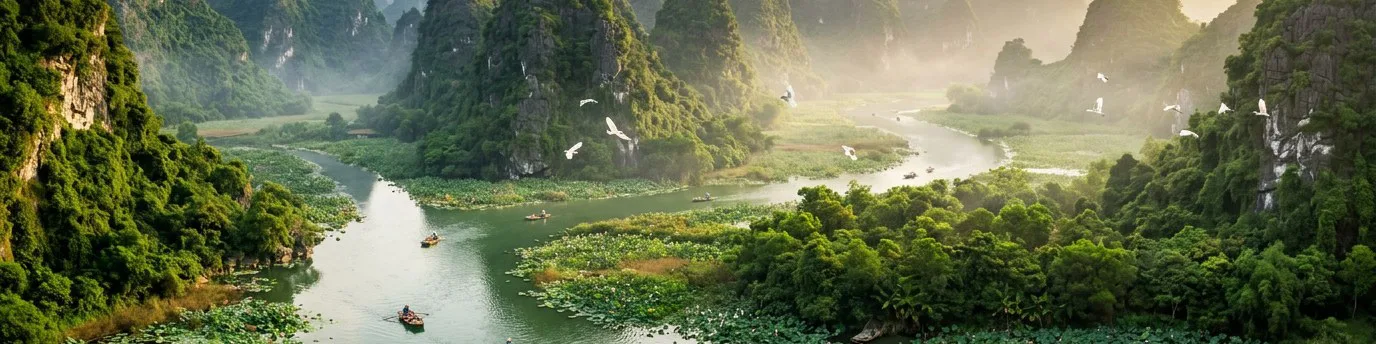
Situated on the northeastern edge of Sam Son Town in Thanh Hoa Province, the Quang Cu Ecotourism Zone initially took shape across a scenic 354-hectare coastal strip where river estuary meets open ocean. Extending seamlessly northward from Sam Son's famous bathing beaches, Quang Cu possesses a tranquil network of freshwater and brackish lagoons teeming with wild shrimp, mud crabs, and estuarine fish, all sheltered behind emerald belts of windbreak casuarina pines that stabilize the coastal sand dunes. Travelers exploring nature reserves and coastal retreats in Northern Vietnam find Quang Cu a refreshing alternative to crowded urban promenades.
Coastal Nature, Stilt Houses, and Community Hospitality
At Quang Cu, visitors immerse themselves in coastal ecology while enjoying hands-on rural pastimes: casting lines for lagoon fish, netting brackish-water shrimp, paddling wooden boats across quiet waterways, and exploring traditional Thanh Hoa fishing and craft villages. Overnight lodging blends vernacular Vietnamese charm with contemporary seaside comfort, offering timber stilt houses, garden bungalows, canvas beach tents, thatched cottages, and rustic country farmsteads.
Powdery sandbanks, whispering casuarina needles, and rolling blue waves create a serene seaside atmosphere just minutes north of central Sam Son Beach. After swimming in the salty surf, guests can rinse off and relax beside expansive inland lakes or angle for supper right from shaded embankments. Since ecological tourism took root here, local families have actively invested in welcoming hospitality services. Starting from the summer of 2002, more than 30 local households established seafood dining pavilions and homestay lodges for holidaymakers. As local resident Nguyen Si Thuc Anh shared, his family invested over 100 million VND to construct a breezy wooden stilt house tailored for overnight coastal travelers.
Low-slung wooden stilt houses peeking beneath tall casuarina canopies have since become the architectural signature of Quang Cu's eco-resorts. Guests can recline on open timber verandas under cool pine shade, listen to the rhythmic murmur of Atlantic-like swells, and savor freshly steamed crabs and grilled estuarine fish. At the northern tip of the sunlit golden beach lies Hoi Port (Cang Lach Hoi), the dramatic river mouth where the mighty Ma River pours into the East Sea. Boat excursions around Sam Son regularly depart from Hoi Port, cruising past Quang Cu's ecological wetlands toward main Sam Son Beach and the forested promontory of Truong Le Mountain. For travelers who enjoy pairing seaside estuaries with inland wetland birding or highland forests, routes in Northern Vietnam also connect well with lake and stork sanctuaries in Hai Duong and primordial Khe Ro forests in Son Dong, Bac Giang.
Master Planning Scope and Five Functional Ecological Zones
Designed as a clean, well-serviced coastal ecological complex meeting modern domestic and international hospitality standards, Quang Cu balances environmental preservation with upgraded technical and social infrastructure. Located in Quang Cu Commune on the northeast side of Sam Son Town—roughly 16 kilometers east of Thanh Hoa City—the expanded master plan encompasses 432.25 hectares. Its geographical boundaries meet the Ma River to the north, Trung Son Ward to the south, the East Sea to the east, and Nguyen Du Road along its western edge. While southern island sanctuaries like coral-fringed Hon Bay Canh Island focus on offshore marine protection, Quang Cu organizes its 432.25-hectare coastal footprint into five complementary functional zones:
- Premium Eco-Resort Zone (32.76 hectares): Dedicated to low-density upscale ecological resorts combining high-comfort amenities with contemporary architecture inspired by traditional Vietnamese spatial aesthetics.
- Urban Tourism Zone 1 (55 hectares): Serving as the transitional gateway between historic Sam Son Beach Town and the new Quang Cu ecological shoreline, featuring hotels, coastal villas, seafood restaurants, visitor service centers, sports facilities, and landscaped green corridors.
- Urban Tourism Zone 2 (108.5 hectares): Designed around high-greenery ecological standards where natural dune woodlands interlace with garden villas and diverse architectural styles, preserving quiet, contemplative spaces suited to nature retreats.
- Residential and Civic Urban Area (151.21 hectares): Incorporating neighborhood subdivisions, community resettlement housing, public facilities—including markets, post offices, clinics, supermarkets, and kindergartens—alongside a water park, protective woodland belts, and landscaped ecological lakes.
- Ma River Ecological Dyke Zone (40.96 hectares): Reserved strictly for protective coastal reforestation and scenic freshwater lakes that buffer the Ma River estuary and sustain long-term ecotourism habitats.