Covering roughly 2,360 square kilometers with a population of 1.3 million residents, Ben Tre is one of the thirteen provinces of the Mekong Delta and is fondly known across Vietnam as the Land of Coconuts as well as a premier kingdom of tropical fruits and ornamental flowers. Shaped by fertile alluvial soils and a warm agricultural heritage, Ben Tre Coconut Ecotourism invites travelers not only to explore shaded canal networks, but also to stay among plainspoken, courteous, generous, and deeply hospitable Mekong families.
Four Mekong Tributaries, Alluvial Islets, and Coastal Mangroves
Ben Tre's geography was formed by rich sediment deposited by four major distributaries of the Mekong River—the Tien, Ba Lai, Ham Luong, and Co Chien rivers—interlaced with hundreds of tidal creeks emptying along 65 kilometers of East Sea coastline. Together, these waterways create three distinct ecological zones spanning freshwater orchards, brackish estuaries, and coastal wetlands. Fertile river islets such as Con Phung (Phoenix Islet), Con Oc (Snail Islet), and Con Tien (Fairy Islet) stay heavy with ripe fruit year-round alongside the renowned Vam Ho Bird Sanctuary, while the coastal districts of Ba Tri, Thanh Phu, and Binh Dai preserve characteristic mangrove belts of Avicennia, Rhizophora, wild mangrove date palms, and Sonneratia trees.
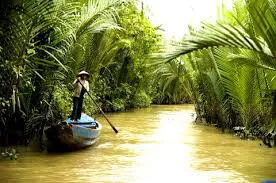
Visitors typically combine kayaking or wooden sampan rowing through water-coconut creeks with horse-cart excursions, leisurely bicycle rides beneath 63,000 hectares of coconut palms—yielding millions of harvested coconut clusters each year—and explorations through more than 33,000 hectares of vibrant fruit orchards. Evenings revolve around traditional Southern Don Ca Tai Tu folk music exchanges and welcoming village homestays where guests share home-cooked meals and daily river life, offering a warm lowland contrast to highland pine trails at Bidoup Nui Ba National Park or limestone island trekking on Cat Ba Island.
Traditional Craft Villages and Signature Coconut Cuisine
Cultural discovery runs deep across the province's rural communes. Cho Lach and Mo Cay Bac districts sustain more than 20 specialized villages cultivating fruit-tree seedlings and ornamental blossoms, while over 30 traditional handicraft villages keep artisanal skills alive. Travelers can visit My Long rice paper workshops, Son Doc puffed cassava cracker bakeries, fragrant coconut candy kitchens, coconut jelly producers, natural coconut cosmetics makers, coconut-shell souvenir carvers, sedge-mat weavers, coir-fiber rope spinners, conical-hat makers, coconut-rib broom workshops, and longan-blossom honeybee farms. Midday feasts celebrate inventive local gastronomy, highlighted by rice steamed inside whole young coconuts, river shrimp sautéed in rich coconut cream, and tender pumpkin simmered in fresh coconut milk.
Expanding Ecotourism Circuits Across Chau Thanh, Cho Lach, and Ben Tre City
Steady investment in rural piers, garden lodges, and community hospitality helped Ben Tre expand from 45 registered attractions in 2010 to 65 active ecotourism venues by 2015, strengthening its standing among Southern Vietnam riverine and wetland destinations and complementing mountain excursions such as forested mountain cascades at Ta Gu Waterfall. Three flagship hubs anchor the province's visitor network:
- Chau Thanh District (34 ecotourism sites): Anchored by the three-star Forever Green Resort, five community homestays across Phu Tuc, An Khanh, Tan Thach, and Quoi Son communes, traditional craft stops, and breezy riverside eco-restaurants including Con Phung, Mien Tay Song Nuoc, Diem Phuong, Three Friends Coconut Village, An Khanh, Tan Quy Islet, and Viet Nhat Restaurant.
- Cho Lach District (12 ecotourism sites): Focused on lush rambutan and mangosteen orchards, ornamental flower nurseries, the Phu Da Rice Snail Sanctuary, and six atmospheric homestays—Nam Hien, Phong Tuc Viet, Jardin du Mekong in Hoa Nghia, Mai Thanh Van, Dai Loc, and Tam Loc.
- Ben Tre City (11 ecotourism sites): Featuring refreshed suburban river circuits that take cyclists and boat passengers past traditional brick kilns, coconut-husking and processing yards, sedge-mat weaving hamlets, and sweet green-skin pomelo gardens.
Backed by convenient boat and road links, strong community consensus, and sustainable stewardship of its canals and orchards, Ben Tre continues to turn coconut-country heritage into one of the Mekong Delta's most resilient ecotourism models.