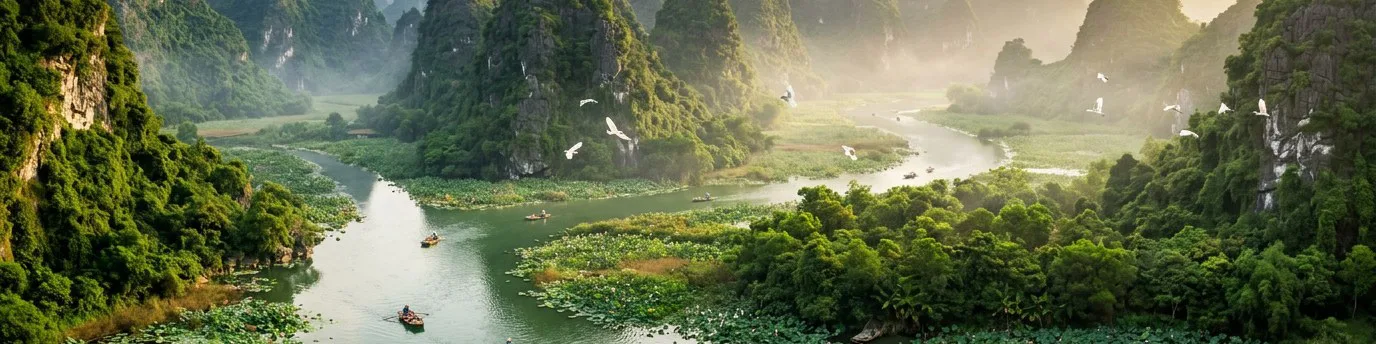

For nature travelers eager to witness the untamed wetland heritage of Vietnam's southernmost tip, U Minh Ha National Park in Ca Mau Province stands out as an unmissable sanctuary. Officially established on November 20, 2006, Lower U Minh National Park consolidated the historic Vo Doi Nature Reserve with surrounding wetland tracts of the U Minh Ha forestry system across U Minh III and Tran Van Thoi. Today, U Minh Ha ecotourism invites visitors into an extraordinary 8,527-hectare core reserve spanning U Minh and Tran Van Thoi districts. At its heart lies the 3,600-hectare Vo Doi sector—the sole surviving primeval peat-swamp forest in Ca Mau Province—encircled by a buffer zone of more than 25,000 hectares managed by the U Minh Ha Forestry Company and the Wetland Forest Applied Research Center to safeguard rare endemic species listed in both the Vietnam Red Data Book and the IUCN Red List. Travelers exploring Mekong Delta waterways often complement Ca Mau with shaded coconut-river ecotourism tours in Ben Tre Province.
Peatland Geology, Acid Sulfate Soils, and Seasonal Flooding
U Minh Ha National Park features flat lowland topography with average elevations ranging from 1.5 meters to 2.5 meters above sea level, subtle internal forest relief between 0.5 meters and 2.0 meters, and a gentle natural tilt from northwest toward southeast. Across the forest stand, soil scientists map two primary soil formations: nutrient-dense peat land covering 1,664 hectares (22.7 percent of the park) and alluvial clay soils covering 6,863 hectares (77.3 percent of the park).
This rare peatland formed over thousands of years as ancient marine basins gradually filled with coastal alluvium carried down by the Mekong River system. Combined with dense flooded-forest vegetation and thick fallen leaf biomass decomposing under anaerobic conditions during annual seasonal inundation—which submerges the forest floor for five to six months each year, typically from June through October—organic matter accumulated into rich peat horizons measuring 0.5 meters to 1.0 meter thick. Directly beneath the dark peat rests a grey marine clay stratum containing potential acid sulfate soil horizons at varying depths.
Travel Access, Watchtower Views, and Living Botanical Museum
Located roughly 25 kilometers west of downtown Ca Mau City—just over thirty minutes by car along paved provincial roads—U Minh Ha National Park immerses guests in a classic cajuput forest ecosystem dominated by Melaleuca cajuputi thriving on seasonally flooded peat and alkaline-alum soils. Few wetland ecosystems of this kind survive anywhere in Vietnam or Southeast Asia, making the park vital for botanical research, native genetic conservation, sustainable eco-travel, and historical remembrance as a steadfast Southern resistance base. Visitors planning extended southern itineraries can browse our complete archive of Southern Vietnam ecotourism destinations.
Climbing the 25-meter central forest observation tower, travelers are greeted by a sweeping 360-degree emerald sea of swaying Melaleuca crowns, open sedge meadows, and glinting amber waterways that underscore the vastness of the Mekong wilderness. Beneath that canopy thrives a living botanical museum comprising three primary vegetation communities: semi-natural Melaleuca forest, restored Melaleuca plantations, and seasonally inundated grasslands. Botanists have recorded 78 vascular plant species across 65 genera and 36 families:
- Canopy Trees: Dominated by cajuput (Melaleuca cajuputi) alongside wetland trees such as mop (Alstonia spathulata), bui (Ilex cymosa), wild java plum (Eugenia jambolana), and tram san (Eugenia lineata).
- Understory Shrubs and Climbers: Purple melastome (Melastoma polyanthum), spiny swamp palm (Licuala spinosa), climbing maidenhair fern (Lygodium microphyllum), three-leaved cheo shrub (Euodia lepta), and forest buoi bung (Acronychia laurifolia).
- Herbaceous Groundcover and Reeds: Tall tropical reed (Phragmites karka), edible swamp climbing fern choai (Stenochlaena palustris), eel-tail sedge (Machaerina falcata), water rattan (Flagellaria indica), and diverse aquatic ferns and freshwater algae.
Extraordinary Wetland Wildlife, Bird Rookeries, and Canal Fisheries
U Minh Ha's sheltered peat swamps support remarkable vertebrate abundance—161 core terrestrial species across 66 families and 27 orders—distinguished not only by species richness but also by dense, thriving populations:
- Mammals (over 40 species): Wild boars, sambar and muntjac deer, golden long-tailed macaques, elusive fishing and leopard cats, civets, large Lyle's flying foxes (fruit bats that gave Vo Doi—"Bat Hill"—its name), weasels, and the globally endangered hairy-nosed otter.
- Waterbirds and Forest Birds (over 182 species): Rare wetland flyers including lesser adjutants, purple swamphens, watercocks, oriental darters, spot-billed pelicans, whistling ducks and cotton teals, grey and purple herons, white and black storks, dwarf bitterns, cormorants, and white-collared kingfishers.
- Reptiles, Amphibians, and Freshwater Fish: Over 36 reptile species across 16 families and 3 orders—monocled cobras, king cobras, banded kraits, Burmese and reticulated pythons, Asian water monitor lizards, tokay geckos, shelled marsh tortoises, golden box turtles, Asian leaf turtles (rua rang), and Malayan snail-eating box turtles—alongside 11 amphibian species across 5 families and 2 orders.
Crisscrossing the forest floor are more than 100 kilometers of shaded canals spanning over one million square meters of permanent open water surface, excluding the vast expanses of seasonally flooded sedge grasslands. Together, these calm black-tea-colored waterways create an ideal nursery where native Mekong freshwater fish feed and multiply year-round. During the traditional angling season, visitors gliding by wooden sampan easily observe and catch prized local species valued for both ecological science and rural cuisine—including striped snakehead (ca loc), golden walking catfish (ca tre vang), climbing perch (ca ro dong), snakeskin and colorful butterfly gouramis (ca sac ran and ca sac buom), spotted catfish, and bronze featherbacks (ca thac lac).
Because the Melaleuca wetland habitat remains well sheltered and strictly conserved, countless rare species gather here in extraordinary numbers. Visitors exploring the interior channels can witness bustling fruit-bat roosts, expansive stork gardens, and noisy heron nesting troughs where thousands of waterbirds take wing across the afternoon sky. Official recognition by UNESCO designating Lower U Minh National Park within the Mui Ca Mau World Biosphere Reserve brought lasting pride to Ca Mau Province and Vietnam's conservation community. As phase-one eco-visitor infrastructure—ranging from boardwalk trails and canal piers to interpretive stations—continues expanding, U Minh Ha stands ready as an unforgettable wetland destination for both domestic and international travelers. Nature lovers exploring southern forests and islands can also discover tropical forest waterfalls and parks in Dong Nai Province or read essential marine and forest travel tips for Phu Quoc.