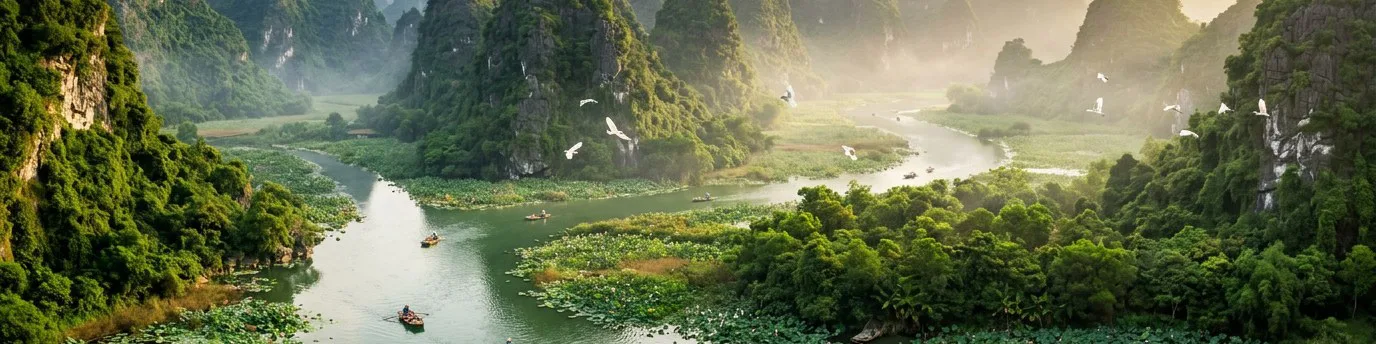
Celebrated across the Mekong Delta as the Land of Pink Lotus, Dong Thap Wetland Ecotourism weaves together internationally protected flooded melaleuca forests, rare migratory crane habitats, reverent historical monuments, century-old floriculture villages, ancient Funan archaeological mounds, and silt-enriched riverside fruit orchards. Positioned between the Tien River and Hau River in the heart of Dong Thap Muoi (the Plain of Reeds), Dong Thap Province preserves an extraordinary mosaic of natural biodiversity and Southern Vietnamese heritage across every season of the year.
Tram Chim National Park in Tam Nong: Ramsar Sanctuary of the Sarus Crane
Spanning a natural area of 7,612 hectares across five communes—Tan Cong Sinh, Phu Duc, Phu Tho, Phu Thanh, and Phu Hiep—as well as Tram Chim Town in Tam Nong District, Dong Thap Province, Tram Chim National Park stands as a living miniature of the ancient Plain of Reeds ecosystem. Its seasonal wetlands, wild rice meadows, lotus lagoons, reed beds, and cajeput forests nurture roughly 130 vascular plant species alongside hundreds of terrestrial and aquatic vertebrates, dozens of native Mekong freshwater fish species, and more than 198 species of waterbirds—accounting for approximately one-quarter of all bird species recorded in Vietnam.
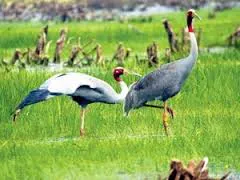
Among Tram Chim's avian residents are numerous rare and globally threatened species, including the white-winged duck, yellow-wattled lapwing, spot-billed pelican, lesser adjutant, and bare-necked darter. Above all, the park is world-famous as the dry-season refuge of the eastern Sarus crane, affectionately known as the red-headed crane and safeguarded on the IUCN Red List due to severe global population decline. Honoring this ecological significance, Tram Chim National Park was officially designated the 2,000th Ramsar Site of international wetland importance in the world and the 4th Ramsar Site in Vietnam. Every year from late December through early May, as floodwaters recede and sedge tubers ripen in the marshes, graceful flocks of red-headed Sarus cranes glide down to Tram Chim to forage harmoniously beside egrets, storks, and wild ducks.
Supported by sustained state investment and partnerships with international conservation organizations, Tram Chim National Park continues to expand its role as an open-air natural history museum and flagship center for sustainable Mekong Delta nature travel, standing alongside coastal biospheres such as the Vam Sat mangrove biosphere ecological resort.
Nguyen Sinh Sac Historical Monument in Cao Lanh City
Right in the urban heart of Cao Lanh City, the 3.6-hectare Nguyen Sinh Sac Monument Complex honors Pho Bang Nguyen Sinh Sac—the revered Confucian Junior Doctoral Laureate, patriotic itinerant physician, and father of President Ho Chi Minh—whose deep bond with the people of Cao Lanh left an enduring moral legacy. Construction of the memorial complex was inaugurated on December 13, 1977, and on April 9, 1992, the Ministry of Culture and Information officially recognized the site as a National Historical and Cultural Monument.
Architecturally and symbolically, the complex is organized into three harmonious zones: the Tomb of Pho Bang Nguyen Sinh Sac, Uncle Ho's Stilt House and Fishpond Replica, and spacious lotus gardens. Facing east, the tomb rests beneath a sweeping white arch sculpted as a stylized lotus petal resembling an upturned sheltering hand, crowned by nine stylized dragons representing the people of the nine-branch Mekong Delta lovingly protecting the scholar's resting place. The rectangular grave itself is clad in polished dark grey marble with a solemn stone incense censer set before the dome, accompanied by an exhibition gallery chronicling Nguyen Sinh Sac's life and travels. Directly in front of the tomb spreads a five-pointed star-shaped lotus pond anchored at its center by a towering 6.5-meter white lotus monument, symbolizing both Nguyen Sinh Sac's pure integrity and Dong Thap's resilient lotus spirit rising proudly within Vietnam.
Adjacent to the tomb area stands an exact 1:1 scale wooden replica of President Ho Chi Minh's stilt house in Hanoi, thoughtfully built so Southern citizens who have not yet traveled north can experience his modest living quarters firsthand. Shaded walkways wind among hundreds of rare fruit trees, fragrant blossoms, and ornamental specimens donated by farmers and provinces nationwide. Every year on the 27th day of the 10th lunar month, visitors from near and far gather in Cao Lanh to commemorate Pho Bang Nguyen Sinh Sac's anniversary in a solemn yet vibrant traditional festival steeped in Southern gratitude.
Gao Giong Melaleuca Forest: The Emerald Oasis of the Plain of Reeds
Tucked inside Hamlet 6 of Gao Giong Commune, Cao Lanh District, the Gao Giong Ecotourism Park—fondly known as Gao Giong Bird Sanctuary—has long been celebrated as a tranquil "green oasis" capturing the quintessential lowland wilderness of Dong Thap Muoi. Gao Giong reaches its peak splendor during the annual Mekong flood season from September to November, when rising river waters blanket the surrounding fields and transform the forest into an emerald island beneath vast skies. Bright golden sesbania blossoms, violet water lilies, soft pink lotus blooms, and deep green melaleuca canopies reflect across mirror-still canals. Visitors paddling wooden sampans—an experience as peaceful as Trang An wetland boat travel experiences in the north—can savor rustic Southern country dishes, taste local herbal rice liqueur lightly infused with wild melaleuca blossom honey, and sway gently in woven hammocks beneath cool wetland breezes.
Widely regarded as the green lung of Dong Thap Muoi, Gao Giong's melaleuca forest spans roughly 1,700 hectares, including 250 hectares of strictly conserved primary cajeput woodland laced with natural seasonal marsh depressions (locally called lung), wild reeds, lotus beds, and water lilies. Year-round, the sanctuary provides safe nesting and roosting grounds for purple swamphens, little cormorants, lesser whistling ducks, common teal, grey herons, and wild ducks, topped by tens of thousands of snow-white egrets that make Gao Giong the largest stork sanctuary in the entire Plain of Reeds. During the flood months, thousands of white storks wheeling against the emerald melaleuca treetops create an unforgettable living panorama, while down in the lotus-filled marshes, flocks of crimson-billed purple swamphens leisurely peel tender young lotus stems and perform spirited courtship dances.
Sa Dec Flower Village: A Century of Mekong Floriculture and Bonsai Art
Whenever travelers speak of ornamental gardens and Tet holiday blossoms in Southern Vietnam, Sa Dec immediately comes to mind. For more than a century, Sa Dec has earned nationwide acclaim for traditional floriculture and master bonsai artistry, supplying vibrant potted blooms and sculpted trees across the Mekong Delta, Ho Chi Minh City, Central Vietnam, neighboring Cambodia, and international export markets. Historically concentrated in Tan Quy Dong Ward of Sa Dec City across roughly 60 hectares tended by 600 to 3,600 specialist gardening households, Sa Dec Flower Village has expanded rapidly in recent years to 177 hectares—adding an average of 10 hectares annually—and now produces more than 10 million flower pots of every variety each year.
Strolling the elevated bamboo trellises of Tan Quy Dong in any month of the year surrounds visitors with a kaleidoscope of color and delicate botanical fragrance. Rows of dahlias, hydrangeas, tropical orchids, dwarf areca palms, fragrant water jasmine, Japanese cycads, French marigolds, yellow, crimson, and violet hibiscus, ornamental chili peppers, moss roses, periwinkles, and golden chrysanthemums bloom side by side above shimmering irrigation canals. Yet the undisputed queen of Sa Dec's nurseries remains the rose, with more than 50 distinct rose cultivars preserved by local growers: deep crimson velvet roses, purple-lotus Grada roses, pastel pink Cleopatre roses, coral-terracotta Korokit roses, pink-and-white Marseille roses, classic blush-red Elizabeth roses, warm golden-yellow Confidence roses, and glowing orange-pink Maccasa roses.
Equally impressive, Tan Quy Dong shelters rare, centuries-old bonsai specimens whose gnarled trunks and graceful canopies embody classical Eastern philosophy. Humble trees familiar to every Vietnamese village courtyard—starfruit, areca palm, cluster fig, sacred bodhi, benjamin fig, and golden apricot blossom—are patiently trained by Sa Dec's master artisans into living sculptures of extraordinary balance, leaving visitors refreshed by quiet rural serenity.
Go Thap National Relic: Ancient Funan Heritage Amid Lotus Marshes
Covering 320 hectares across My Hoa and Tan Kieu Communes in Thap Muoi District—situated 11 kilometers north of Thap Muoi's district center and 43 kilometers northeast of Cao Lanh City—the Go Thap Relic Complex unites deep archaeological mystery with pristine wetland scenery. Designated a National Historical and Cultural Monument by the Ministry of Culture and Information in 1998, Go Thap encompasses five signature heritage landmarks: Go Thap Muoi (Ten-Story Tower Mound), the Ancient Tower Pond, the Tomb and Temple of Doc Binh Kieu, Go Minh Su, and Ba Chua Xu Temple.
Archaeological excavations across Go Thap have unearthed brick temple foundations, ancient inscriptions, statues, and gold artifacts belonging to the brilliant Oc Eo civilization, pointing to a thriving religious and urban center of the ancient Kingdom of Funan some 1,500 years ago. Centuries later, during Vietnam's two resistance struggles against French colonial and American forces, Go Thap's remote reed marshes served as the strategic revolutionary base for Southern Administrative Agencies, Zone 8, and Military Region 8. Today, two major traditional folk festivals draw hundreds of thousands of pilgrims each year: the Via Ba Chua Xu Festival on the full moon of the 3rd lunar month and the solemn commemoration of national heroes Thien Ho Vo Duy Duong and Doc Binh Nguyen Tan Kieu on the 15th day of the 11th lunar month.
First-time visitors to Go Thap are often delighted to discover not only ancient brick ruins, but an untamed Plain of Reeds landscape. In the dry season, winding ancient sand mounds rise gently beneath the vast shade of centuries-old calophyllum and forest trees; during the flood season, endless fields of pink lotus and emerald wetland grasses encircle the mounds in breathtaking stillness.
Dong Thap Alluvial Orchards: Cao Lanh Mangoes, Chau Thanh Longan, and Lai Vung Pink Tangerines
Every year, the sweet floodwaters of the Tien River and Hau River deposit rich alluvial silt across Dong Thap's islands and riverbanks, nurturing prosperous villages and lush, fruit-laden orchards celebrated throughout our Southern Vietnam wetlands and Mekong reserves and rivaling tropical island getaways like the Hon Tam marine ecotourism sanctuary. Four regional fruit specialties have made Dong Thap a household name across Vietnam: Cao Lanh mangoes, Chau Thanh longan, Phong Hoa pomelos, and Lai Vung pink tangerines.
Cao Lanh District proudly bears the title "Kingdom of Mangoes," cultivating more than 4,000 hectares of mango gardens, over half of which are devoted to prized Cat Hoa Loc and Cat Chu cultivars alongside fragrant Thom mangoes, large Tuong mangoes, Gon mangoes, crisp Coc mangoes, and Thanh Ca mangoes. Each variety offers its own golden hue and honeyed aroma, inspiring the beloved Mekong folk verse: "No mango tastes finer than Cao Lanh mango; no star apple tastes sweeter than Can Tho star apple."
Downstream in Chau Thanh District, sprawling longan orchards bend low with clusters of golden-brown fruit each harvest season, inviting travelers to pluck ripe longans straight from the branch and savor their crisp, translucent, fragrant flesh—a Southern delicacy often compared to Northern Vietnam's famed Hung Yen royal longan. Meanwhile, Lai Vung District captivates springtime travelers with more than 1,000 hectares of celebrated pink tangerines. In the weeks before the Lunar New Year, Lai Vung's orchards glow like lanterns with heavy clusters of large, glossy, golden-orange mandarins bursting with refreshing sweet-tart juice. Cruising gently along the Tien and Hau rivers while sampling fresh orchard fruit and watching emerald river islets drift past completes the quintessential Dong Thap ecotourism experience.